
Pallet Shrinkage: Why Pallets Disappear and How to Stop the Losses
Typical shrinkage rates, the five real causes behind “vanished” pallets, and concrete countermeasures for goods-in.
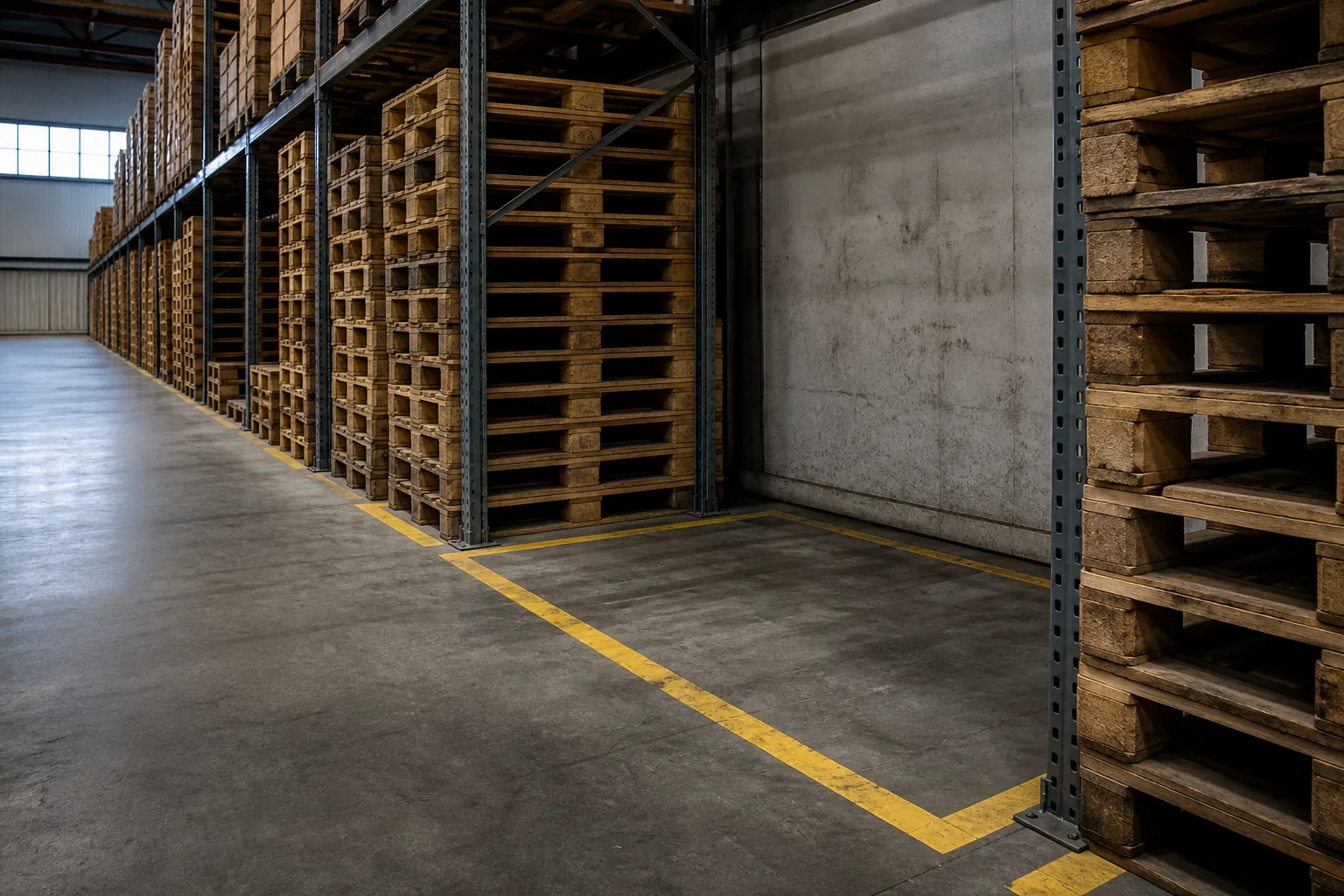
Pallet shrinkage is the difference between the pallets your process expects and the pallets that can still be allocated or settled later. In many mid-sized warehouses, unexplained rates sit at 2–5 % of movements. At an average value of €12 and 300 movements per week, 3 % already comes to around €5,600 per year — often without anyone ever “seeing a pallet get stolen”.
Shrinkage is rarely a single event. It is the sum of counting errors, undocumented substandard quality, open exchange balances, and genuine outflow. Anyone who only maintains the pallet account sees the balance. This article explains why the balance is bleeding and which five measures bring the rate down.
What a Realistic Shrinkage Rate Looks Like
There is no official industry figure. From reconciliations with logistics managers and from what accounts show after year-end close, a reliable grid emerges:
| Situation | Typical unexplained rate |
|---|---|
| Paper, irregular reconciliation | 4–8 % |
| Excel plus monthly accounts | 2–4 % |
| Digital capture at the loading dock | often below 1–2 % |
| Closed loop, few partners | frequently below 1 % |
Anything above 5 % is not “normal shrinkage”, but a missing process. Anything below 1 % without a system is chance or undercounting in the other direction.
The Five Causes That Look Like Shrinkage
1. The Dock Counts Wrong Under Time Pressure
Drivers want to leave, the next tour is waiting. 28 instead of 32 is not theft — but it becomes shrinkage if nobody counts back. A wrong number on the pallet slip migrates into the account and stays there until nobody can assign it to a tour anymore.
2. Quality Is Booked as Quantity
20 pallets in, 20 out: balance zero. If 20 Class A pallets went out and 20 barely exchangeable ones came back, what is missing is the value, not the unit. In the inventory this looks like shrinkage, because the good pallets are “gone”. The classes are explained in the overview of Euro pallet quality classes.
3. Open Balances Without a Deadline
In open exchange the difference is spread across dozens of partners. Without monthly reconciliation, “we'll sort it out” becomes a write-off after six months. That is accounting shrinkage.
4. Genuine Outflow: Theft, Takeaway, Grey-Market Sales
Euro pallets have resale value. Unsecured outdoor storage, unchecked yard departures, and “empty pallets for the driver” are part of it. This share is usually smaller than the process errors — but it exists. Without a photo and timestamp at the dock, you cannot separate it from counting errors.
5. System Breaks: Excel, Slips, a Second Warehouse
One site books, the other does not. A pallet moves internally and never officially leaves inventory. Shrinkage then arises in the software, not on the floor. That is exactly what digitalising pallet returns addresses.
Sample Calculation: What 3 % Really Costs
Assumptions: 300 pallet movements per week, €12 value, 3 % unexplained, 50 effective weeks.
300 × 3 % × €12 × 50 = €5,400 per year in unit value alone.
On top of that:
- labour time for clarification and disputes (often several hours per month),
- value loss through silently accepted substandard quality (often in the same order of magnitude),
- follow-on costs when poor pallets go into high-bay racking or to customers.
If you bring the rate from 3 % down to 1 %, the example leaves €3,600 in unit value plus the avoided clarification time. That is the lever, not the purchase price of the next pallet.
Five Countermeasures That Work at the Dock
1. Capture every movement on the same day. Not the week, not “when there's time”. Shrinkage arises in the gap between handover and booking.
2. Document quantity and quality together. A photo of the returned goods is attached to the transaction. That way substandard quality does not become invisible shrinkage. How to keep evidence is covered in damage documentation.
3. Record discrepancies before departure. Follow-up emails rarely convince. The driver must still be able to confirm the deviation.
4. Reconcile accounts on a fixed rhythm. Weekly for top partners, monthly for the rest. Treat open items older than 60 days like a bad debt — not like a misunderstanding.
5. One process for every gate. The same procedure in shift A and shift B, in warehouse 1 and warehouse 2. Shrinkage rates fall as soon as nobody has “their own Excel” anymore.
These five points are deliberately operational. Strategic levers such as supplier evaluation and reports are covered in the article on costs in pallet logistics.
What Digital Capture Changes About Shrinkage
A system does not replace a count. It makes the count impossible to lose: timestamp, partner, units, photo, export. The discussion then shifts from “Who is right?” to “Which transaction is off?”. In practice the unexplained rate drops because fewer transactions vanish in the no man's land between paper layers.
Anyone who suspects theft needs this transparency first. Otherwise you optimise fences while 80 % of the losses are counting and quality errors.
Conclusion
Pallet shrinkage is almost never just theft. It is the sum of wrong numbers, wrongly booked quality, open balances, and genuine outflow. A rate above 2–3 % is a process problem. Anyone who captures at the dock, records discrepancies immediately, and reconciles accounts on schedule recovers most of the money — often without buying a single extra pallet.
Frequently Asked Questions
What is pallet shrinkage? The unexplained difference between expected pallets and pallets that can still be allocated later — in units or in value, when quality is silently lost.
What shrinkage rate is normal? Below 2 % with well-maintained accounts, often below 1 % with digital capture. Above 5 % is not an industry standard, but missing control.
Are vanished pallets always theft? No. The larger share comes from counting errors, substandard quality, and unreconciled balances. Theft occurs, but it is rarely the only cause.
How do I calculate my pallet loss? Unexplained units × average value, plus estimated labour time for clarification. Relate the rate to movements, not only to inventory.
How do I stop pallet shrinkage fastest? Capture on the day of handover, a photo when there is a deviation, monthly reconciliation of top partners. That works faster than a new fence.

Ready for digital pallet returns?
Try the app now for free and be among the first to use Pallet Terminal.
No credit card required