
Open and Closed Pallet Exchange: Differences, Risks, and What Pays Off
Open pallet exchange shares the pool with everyone; closed stays in your own chain. Differences, account risk, and when each model fits.
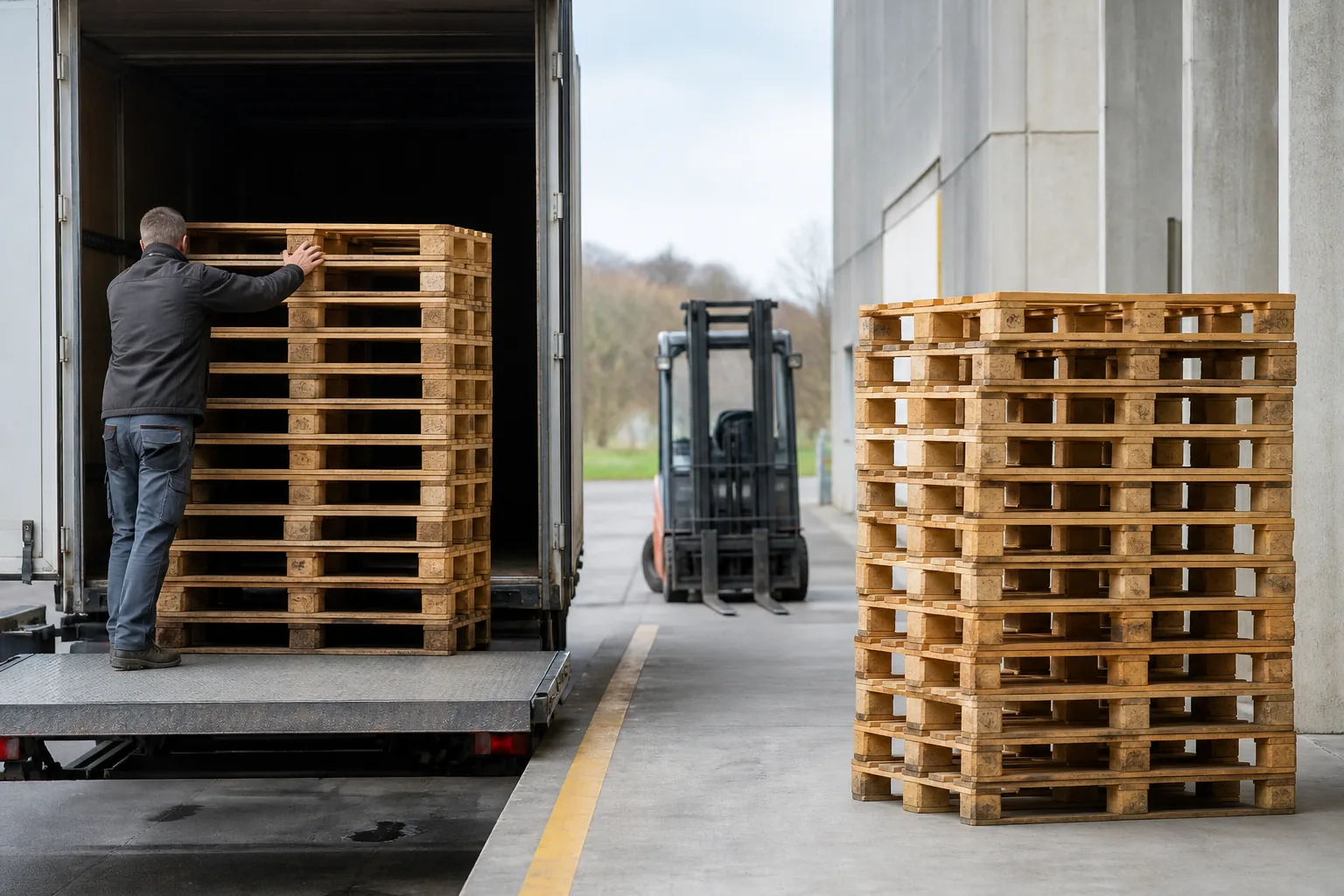
In open pallet exchange, you put exchangeable euro pallets into a shared pool and receive other, equivalent pallets in return — often from a different company than the one you delivered to. In closed pallet exchange, the same pallets — or at least the same account system — stay within a defined partner chain. The difference determines shrinkage, quality, and administrative effort — not the wood dimensions.
Both models are contractual, not statutory. There is no legal right to exchange at the loading dock. Anyone who does not clearly agree the model often ends up in the open pool in practice — with all the risks, without having the rules in writing.
The Difference in One Sentence
Open: pallet for pallet, quality according to pool rules, balances across many partners. Closed: pallet or credit only within defined relationships, often with return of the same load carriers.
| Criterion | Open exchange | Closed exchange |
|---|---|---|
| Participants | wider circle (pool) | defined partners |
| Ownership | effectively changes continuously | remains controllable |
| Quality | pool average | controllable by contract |
| Accounts | many small balances | few clear cycles |
| Flexibility at the dock | high if stock is available | lower, planning required |
| Shrinkage risk | higher, hard to assign | lower, easier to contain |
| Typical system | EPAL exchange pool | own cycles, often pooling |
Open exchange is why the euro pallet feels so natural in DACH and CEE. Closed exchange is the answer when quality, hygiene, or traceability matter more than maximum flexibility.
How Open Pallet Exchange Works
You deliver goods on exchangeable EPAL pallets. The receiver returns — if agreed and available — the same number of exchangeable pallets. These pallets need not have been "yours." They must meet the EPAL exchange criteria.
The model scales because nobody waits for their own pallet to come back. It creates three structural problems:
Account explosion. Every partner has their own pallet account. Discrepancies spread across dozens of relationships.
Quality drift. Anyone who puts Class A in and gets unsorted stock back loses value even when the count matches. The classes are explained in the overview of euro pallet quality classes.
Proof obligation at the dock. Without an immediately documented discrepancy, open exchange is a matter of trust. That is exactly where the five most common exchange mistakes sit.
How Closed Pallet Exchange Works
In the closed model, sender and receiver (sometimes plus the carrier) define the cycle themselves. Variants:
- Tit for tat in the same relationship. You get pallets back only from the partner you delivered to.
- Own coloured or marked pallets. Foreign pallets are not accepted.
- Hire or pooling cycle. A service provider supplies pallets and collects them — closed relative to the open EPAL pool, but internally a service. You will find the system comparison under EPAL, CHEP or LPR.
The advantage: quality and shrinkage can be assigned to one circle. The price: less flexibility. If no exchange pallets are ready on Friday afternoon, the truck stands still — or you drop unplanned into the open pool and destroy the system.
Account Risk: Why Open Exchange Costs More Than It Looks
In the open pool, shrinkage is rarely theft in the classic sense. More often it is an unassigned discrepancy: 2 pallets short here, 3 worse ones there, a lost pallet slip. Over a year that becomes a shrinkage rate nobody can assign to a single transaction.
A calculation example: 400 movements per week, open exchange, 2 % unexplained discrepancy, €12 average value.
400 × 2 % × €12 × 50 weeks = €4,800 per year — without a single "lost" load in the classic sense. In a closed cycle with monthly reconciliation, the same rate often drops below 1 %, because every discrepancy has only one contact person.
The Quality Trap in the Open Pool
Open exchange assumes equivalence. The reality in circulation is unsorted. Anyone who needs high-rack storage or food hygiene must not accept Class C as a full exchange — even if the driver expects "pallet for pallet."
That is why the contract must specify not only "we exchange," but:
- which model (open / closed),
- what minimum quality,
- what happens in case of shortage or inferior quality (subsequent delivery, credit, invoice),
- what the document looks like (slip or digital).
Which Model Fits When?
Open exchange pays off when you have many changing partners, move standard goods on EPAL, and the dock must stay fast. Prerequisite: clean capture and monthly accounts.
Closed exchange pays off when quality, hygiene, automated warehouses, or a manageable partner circle justify the effort — or when the open pool consistently returns worse pallets than you put in.
Many mid-sized companies run a hybrid: regular customers closed, spot traffic open. That only works if goods-in recognises the model per transaction and does not dump everything into one Excel sheet.
Conclusion
Open pallet exchange maximises flexibility and spreads the risk across the entire pool. Closed exchange maximises control and concentrates the risk on a few relationships. Neither model frees you from documentation. Anyone who does not define model, quality, and document pays the costs of the open pool — without reliably using its advantages.
Frequently Asked Questions
What is open pallet exchange? The exchange of exchangeable pallets in a shared pool. You do not get your own pallets back, but equivalent ones from circulation.
What is closed pallet exchange? The cycle stays in a defined partner chain or with a pooling service provider. Foreign pool pallets are not accepted, or only according to a rule.
Is pallet exchange required by law? No. It is based on contract or general terms. Without a rule, there is no claim to exchange pallets.
Which model is cheaper? Open is cheaper to handle at the dock, often more expensive through shrinkage and quality loss. Closed costs more steering, but saves unexplained balances.
Can I use both models in parallel? Yes, as a hybrid — but only with clear labelling per partner and transaction. Otherwise the accounts mix.

Ready for digital pallet returns?
Try the app now for free and be among the first to use Pallet Terminal.
No credit card required