
Damage Documentation at the Loading Dock: Legally Secure Evidence in 5 Minutes
Legal requirements for damage documentation, statutory deadlines and why smartphone photos alone aren't enough.

Every day, hundreds of thousands of pallets are unloaded at loading docks — and a surprisingly high proportion show signs of damage. The problem: anyone who fails to document transport damage immediately and in a legally compliant manner loses their claims in the event of a dispute. The burden of proof lies with the recipient, and the statutory deadlines are tight.
Yet damage documentation at many loading docks is still treated as an afterthought. Sometimes time is lacking, sometimes a systematic approach, sometimes the right tools. The result: companies end up bearing costs that should rightfully be borne by the party at fault.
Why evidence collection at the loading dock is critical
The loading dock is the critical handover point in the supply chain. This is where responsibility for the goods — and with it, liability — changes hands. If damage is only discovered in the warehouse or during order picking, proving it existed at the time of delivery becomes virtually impossible.
Without complete documentation at the point of handover, companies lose not only their claims against the carrier or supplier. They also risk internal follow-on costs: damaged pallets can block automated conveyor systems, cause load-securing problems and, in the worst case, lead to personal injury.
Professional evidence collection at the loading dock therefore protects not just the bottom line but also operations.
Legal framework: CISG, UCC and international conventions
International trade law imposes clear obligations on buyers to inspect goods upon receipt and to notify defects promptly. The key provisions at a glance:
The inspection and notice obligation under CISG
The United Nations Convention on Contracts for the International Sale of Goods (CISG) — applicable to cross-border B2B transactions in over 90 countries — requires the buyer to inspect goods within a period as short as practicable (Article 38) and to notify the seller of any non-conformity within a reasonable time after discovery (Article 39).
Failure to give timely notice bars the buyer from relying on the non-conformity — even if the goods are visibly damaged. The right to substitute goods, price reduction or damages is lost.
The deadline for latent defects
Not all damage is immediately visible upon delivery. For such latent defects, CISG Article 39 sets an outer limit of two years from the date of handover, but the "reasonable time" for notice is interpreted strictly — courts typically expect notification within 7 to 14 days of discovery. In the United States, UCC §2-607 similarly requires notice "within a reasonable time after the buyer discovers or should have discovered any breach." A reversal of the burden of proof occurs if notice is late: the recipient must prove that the damage existed at the time of handover — which is practically hopeless without documentation.
Consequences of missing deadlines
If notice is not given in time, the recipient forfeits their warranty claims. In practice this means: the recipient bears the cost of damaged pallets, must procure replacements at their own expense and can claim neither a price reduction nor damages.
What legally secure documentation requires
Damage documentation that will withstand scrutiny in court must answer three core questions beyond doubt: what is damaged, when was it discovered, and who is the damage attributable to?
Tamper-proof timestamp
Photos and reports need a verifiable timestamp — not the date from the smartphone's EXIF data, which is easily manipulated, but a time record demonstrably generated at the moment of capture. Only this proves that the documentation was actually created at the time of delivery and not days later.
Photos from multiple angles
A single photo is not enough. Robust documentation requires:
- Overview photo: The entire shipment in context, to make the scope visible
- Close-up shots: Each individual piece of damage up close, so the type and extent are clearly identifiable
- Markings: EPAL brand marks, batch numbers or other identification features
Attribution to supplier and shipment
Photos without context are worthless. Every piece of documentation must be unambiguously linked to a supplier, a delivery note number and a date. Only then can it be proven in a dispute which pallet from which shipment was affected.
Why smartphone photos alone aren't enough

Many companies rely on employees "quickly snapping a photo with their phone." That is better than nothing — but inadequate for legally secure evidence. The typical problems:
Lack of structure: Photos end up in the camera roll between holiday pictures and screenshots. There is no uniform naming convention, no standardised filing. Weeks later, nobody can trace which photo belongs to which delivery.
No reliable timestamp: EXIF data can be altered retrospectively. In a dispute, opposing counsel will argue precisely this — and cast doubt on the entire documentation.
No automatic attribution: Anyone who takes photos must manually note which supplier, which delivery note number and which date the photo belongs to. Under time pressure at the loading dock, this rarely happens completely.
No standardised report: A stack of unsorted photos is not a damage report. A claim requires coherent documentation with damage classification, quantity details and an assessment.
Checklist: 5 steps to legally secure documentation
Step 1: Inspect before unloading
Examine the shipment while still on the vehicle for visible damage. Note any irregularities immediately on the delivery note and have the driver countersign. Without this note, a later claim for obvious damage becomes nearly impossible.
Step 2: Photograph systematically
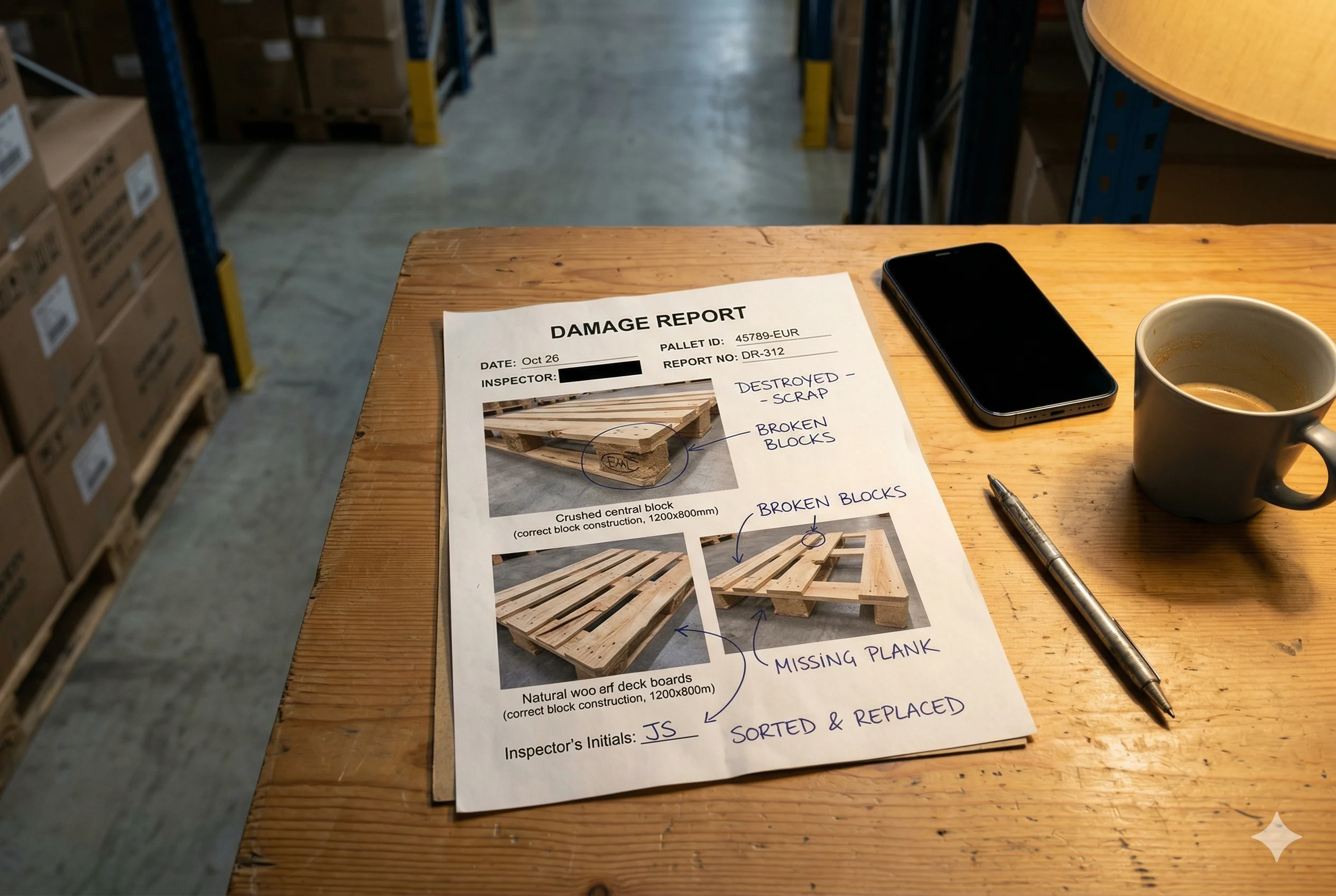
Create at least three photo categories per damage case: overview, detail and markings. Ensure good lighting and sharp images. The correct approach to documenting pallet damage is key here.
Step 3: Classify the damage
Use a standardised assessment rather than free text. Which component is affected? What type of damage is present? Is the pallet still exchange-grade? An AI-powered analysis can automate and objectify this classification.
Step 4: Ensure attribution
Link the documentation unambiguously to the supplier, delivery note number and delivery date. Without this attribution, even the best photo documentation is worthless.
Step 5: Create a report and file within deadlines
Compile all information in a structured report and submit it to the supplier within the statutory deadlines. Archive the report for at least 3 years.
How digital tools complete the process in 5 minutes
Carrying out this checklist manually takes 20–30 minutes per damage case — time that simply does not exist at the loading dock. That is why it is often only partially completed in practice.
Digital solutions for pallet returns solve this problem by mapping the entire process in a guided app:
- Guided capture: The employee is walked through the documentation step by step — nothing is forgotten.
- Automatic timestamp: Every photo is tagged with a server-side, tamper-proof time record.
- Automatic attribution: Supplier, delivery note number and date are entered once and automatically linked to all photos and damage entries.
- AI-powered classification: Instead of manual free-text descriptions, an AI automatically identifies damage types and affected components from the photos.
- PDF report at the push of a button: The result is a legally secure, structured damage report as a PDF — ready to send to the supplier.
What takes 20–30 minutes manually is done in under 5 minutes with the right tool. The employee at the loading dock needs no legal expertise — the app ensures all legal requirements are met.
Conclusion
Damage documentation at the loading dock is not a nice-to-have but a legal necessity. Anyone who fails to meet inspection and notice obligations and does not document damage fully and on time forfeits their claims — and ends up paying out of pocket.
The good news: with the right digital tools, legally secure evidence collection can be completed in 5 minutes. No paperwork, no media discontinuities, no missed deadlines.

Ready for digital pallet returns?
Try the app now for free and be among the first to use Pallet Terminal.
No credit card required