
EPAL, CHEP or LPR: Which Pallet System Fits Your Company?
EPAL open exchange pool versus pallet pooling from CHEP and LPR: ownership, cost logic, tracking, and when each system pays off.
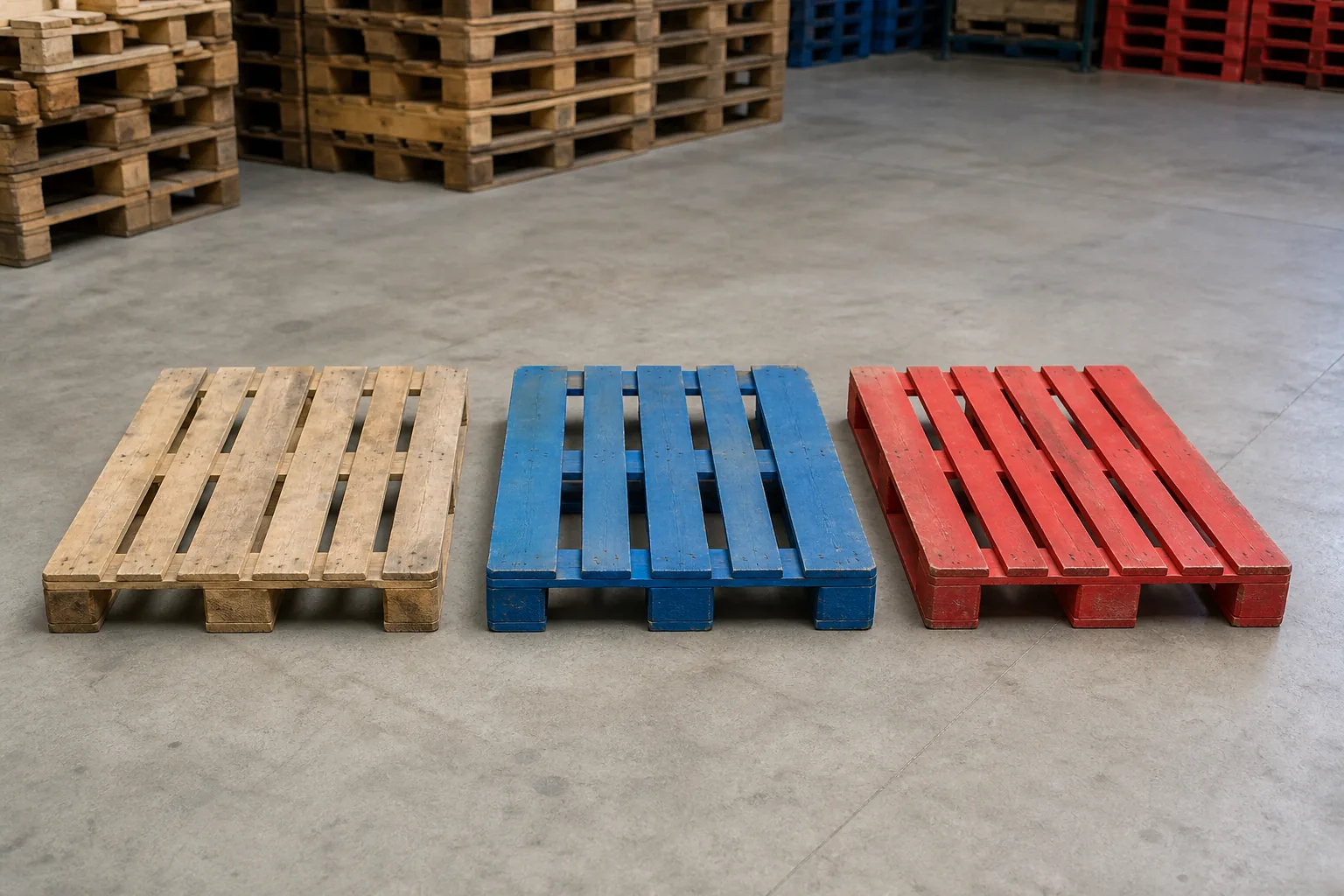
EPAL is an open exchange pool: you buy or exchange standardised wooden pallets and manage the balances yourself. CHEP and LPR are pallet pooling providers: you rent coloured pallets, the service provider owns them, supplies them and collects them. The question is not which logo is better — but whether you want to carry ownership and administration yourself or buy in supply and collection.
All three systems move goods on 1,200 × 800 mm. What differs is ownership, cost trajectory, quality control and the effort at the loading dock.
The three systems at a glance
| Criterion | EPAL | CHEP | LPR |
|---|---|---|---|
| Model | open exchange / ownership | pooling (rental) | pooling (rental) |
| Typical pallet | untreated wooden pallet | blue-painted wooden pallet | red-painted wooden pallet |
| Owner | you or exchange partners | CHEP | LPR (PRP) |
| Start-up costs | purchase price or exchange balance | registration and supply | similar, contractual |
| Ongoing costs | shrinkage, repair, administration | rental and service tariff | rental and service tariff |
| Quality | depends on the pool and your inspection | provider standard, often more homogeneous | provider standard, often more homogeneous |
| Tracking | build it yourself | part of the service | part of the service |
| Flexibility | high, almost every partner | high in connected networks | high in connected networks |
| Typical strength | DACH/CEE, mid-sized companies, spot traffic | retail chains, FMCG, large networks | retail and industrial network Europe |
CHEP and LPR are competitors in the same model, not opposites of “digital versus analogue”. The real contrast is: exchange pallet in the open pool versus rental pallet in the closed service.
EPAL: ownership, flexibility, your own accounts
The European Pallet Association licenses manufacture and repair. You buy pallets or exchange them under the rules of the open pool. Advantages:
- No platform contract needed to start with a new supplier.
- Full control over inventory if you actually keep it.
- Fits existing forwarding and loading-dock routines in DACH.
Disadvantages that cost money in practice:
- Quality drifts if you do not inspect. See quality classes.
- Shrinkage and discrepancies stay with you. See pallet account.
- Administration (vouchers, balances, claims) is internal work.
EPAL is cheap when exchange, quality and accounts are in order. It is expensive when “pallet for pallet” runs uncontrolled.
CHEP and LPR: service instead of ownership
Pooling providers finance the stock, sort out rejects, repair and control availability. You pay for use and logistics, not for the board. Typical process:
- Contract and volume planning with the provider.
- Supply at the shipping location.
- Shipment to recipients registered in the network.
- Collection or onward transfer in the pool, billing by tariff.
When the model wins: stable volumes, recipients already in the respective network, high demand for uniform quality, little appetite for your own pallet bookkeeping.
When it stalls: recipients outside the network, strongly fluctuating spot traffic, mixed operation with EPAL without a clear split at the loading dock, unclear tariff components (rental, transport, loss, detention).
CHEP and LPR differ mainly in network coverage, tariff and operational proximity to your recipients — not in the basic logic. A comparison is only worthwhile with your real relations, not with brochure figures.
Cost logic: purchase price versus total cost
The unit price of an EPAL pallet is visible. The total cost often is not:
EPAL total cost ≈ purchase or exchange value + shrinkage + repair + labour time for accounts + value loss from poorer returns.
Pooling total cost ≈ supply + rental/cycle + collection + contractual minimum volumes + loss fees when pallets leave the network.
A rough orientation for mid-sized companies: if your unexplained shrinkage and quality rate stays permanently above 2–3 % and administration ties up several hours per week, pooling brings some of these hidden EPAL costs forward as a tariff. If your accounts and quality are under control, EPAL often remains the cheaper base — especially with many small partners outside the pools.
Calculation examples for levers independent of the system are in the article Reducing pallet logistics costs.
Tracking and the loading dock: the underestimated difference
Pooling pallets are marked as third-party property. That reduces the chance they quietly disappear into your stock — and increases the pressure to book them correctly. EPAL pallets all look the same. Without a process at the loading dock they are invisible.
Regardless of the system: anyone who does not record quantities and damage at the moment of handover loses the negotiating basis — with the exchange partner just as with the pooling provider. Digitalising pallet returns is therefore not an EPAL topic, but a loading-dock topic. The starting point: digitalising pallet returns.
Decision aid in five questions
- Are your most important recipients already in a pooling network? If yes, CHEP or LPR becomes operationally simple. If not, EPAL remains the standard.
- Can you reconcile pallet accounts monthly? If not, the open pool is more expensive than the purchase price suggests.
- Do you need homogeneous quality for high-rack storage or hygiene? Pooling or a closed exchange is then often calmer than unsorted EPAL returns.
- Does your volume fluctuate strongly? EPAL is more flexible. Pooling contracts like predictability.
- Do you want ownership on the balance sheet or service in the P&L? That is a finance question, not a logistics question — and should be decided deliberately.
Many companies mix: core lanes in the pool, the rest on EPAL. That works if goods-in does not put the systems on the same stack.
Conclusion
EPAL, CHEP and LPR solve the same transport problem with opposite economics. EPAL sells flexibility and demands discipline. CHEP and LPR sell discipline and demand network and tariff. The better system is the one whose total cost you actually know — not the one with the best-known colour.
Frequently asked questions
What is the difference between EPAL and CHEP? EPAL is an open exchange and ownership pool for standardised wooden pallets. CHEP rents out its own pallets and organises supply and collection.
Are LPR pallets the same as CHEP? The same model (pooling), different provider, different colour and different network. The comparison depends on your recipients and tariffs.
Can I mix EPAL and pooling pallets? Operationally yes, in accounting only with a split. On the same stack without marking you lose both systems.
Is pallet pooling always more expensive? Per visible unit often yes. In the total-cost calculation it can be cheaper if EPAL shrinkage and administration are high.
Which system suits mid-sized companies? Often EPAL as the base, pooling on relations where recipients and volumes are stable. A blanket recommendation without relations is not serious.

Ready for digital pallet returns?
Try the app now for free and be among the first to use Pallet Terminal.
No credit card required