
AI in Pallet Logistics: How Computer Vision Is Changing Damage Assessment
How AI and computer vision automate damage assessment for Euro pallets — practical and affordable for mid-sized companies.
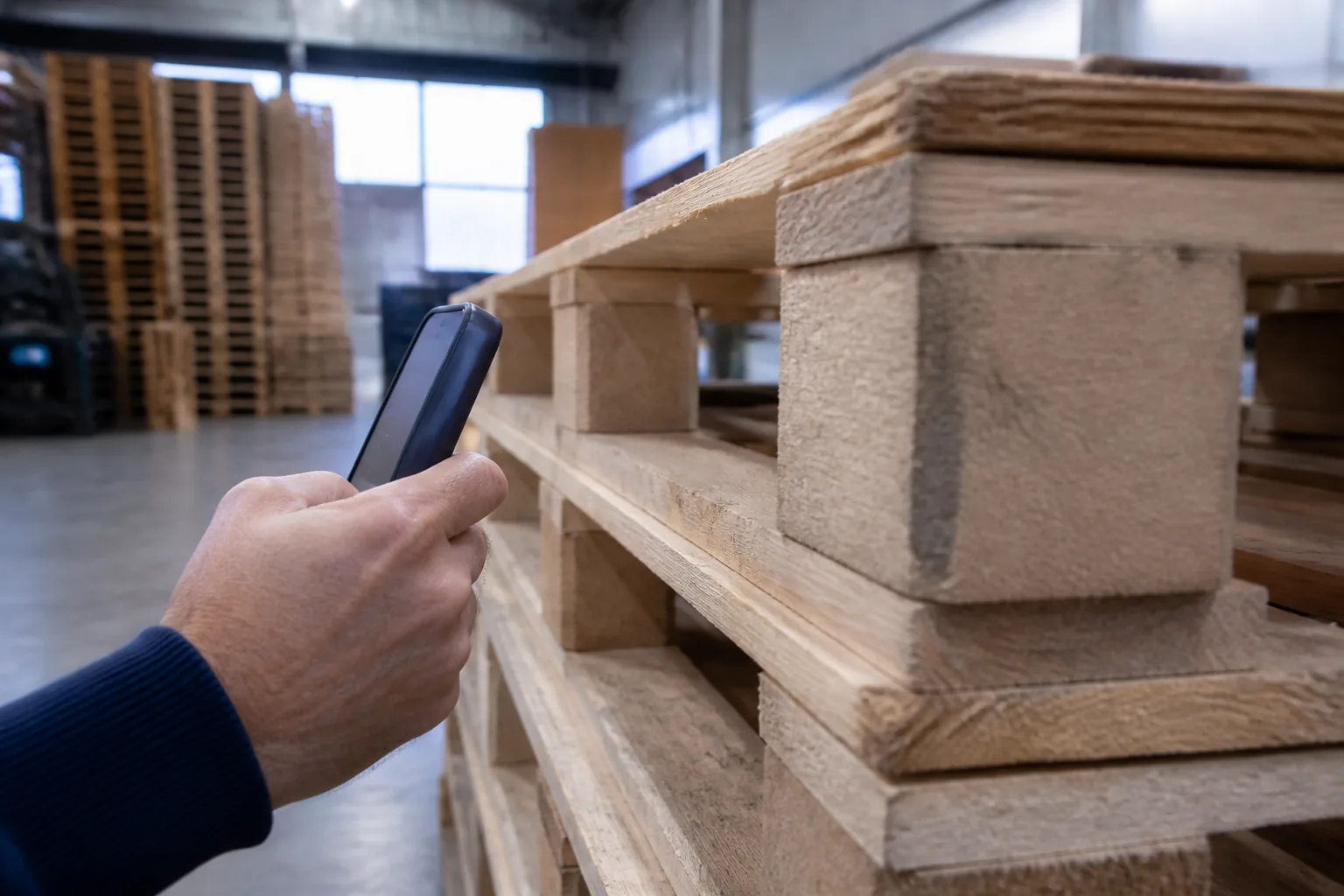
Artificial intelligence has long arrived in logistics — in route planning, demand forecasting, and warehouse management. But at the loading dock, where thousands of Euro pallets move in and out every day, quality control at most companies still relies on visual estimation. That is changing now.
Computer vision — the ability of AI systems to analyze images and extract information from them — makes automated detection of pallet damage not only possible but practical and affordable.
What Computer Vision Can Detect on Pallets
Modern AI models trained on thousands of images of damaged and intact pallets can identify a wide range of defects:
Structural damage: Broken or cracked deck and bottom boards, missing or twisted blocks, damaged stringers. These are the defects that render a pallet non-exchangeable under EPAL criteria.
Surface defects: Protruding nails, severe wood splinters, mold, contamination from oil or chemicals. These defects are safety-relevant and affect the quality classification.
Marking issues: Illegible or missing EPAL branding marks, missing repair nails on repaired pallets, missing IPPC marking.
Dimensional deviations: Pallets that have lost their standard dimensions due to damage and therefore cause problems in automated high-bay warehouses.
How Does This Work in Practice?
There are two fundamental approaches to deploying computer vision in pallet logistics:
Approach 1: Mobile App with AI Analysis
The worker at the dock photographs the pallet with their smartphone. The images are sent to a cloud service that performs the AI analysis. Within seconds, an assessment is returned: Which defects were detected, how severe are they, and is the pallet still exchangeable?
This approach is particularly suited for companies that want to digitize their pallet returns without investing in stationary hardware. The entry barrier is low — a smartphone is all you need.
Approach 2: Stationary Camera Systems
At goods-receiving gates or conveyor lines, permanently installed cameras automatically capture every pallet as it passes through. The AI analyzes the images in real time and sorts out damaged pallets or automatically assigns them to the correct quality class.
This approach is suited for companies with high throughput that aim for a fully automated process. The investment is higher, but the throughput rate and consistency of assessment are superior.
Advantages Over Manual Inspection
Objectivity. Humans assess subjectively — one worker lets a slightly damaged pallet pass, another rejects it. An AI applies uniform criteria every single time.
Speed. A manual inspection takes 30–60 seconds per pallet when done thoroughly. An AI analysis takes under 5 seconds.
Complete documentation. Every analysis is automatically saved — with photo, detected defects, assessment, and timestamp. This is the perfect basis for claims and damage evidence.
Scalability. Whether 50 or 500 pallets per day — AI scales without additional staffing.
What AI Still Cannot Do Today
Honesty matters: AI-based damage detection is not a perfect system. There are limitations you should be aware of:
Hidden damage — when a pallet looks intact from above but the underside is damaged — the AI can only detect what is visible in the photos. That is why capturing images from multiple angles remains important.
Load-bearing assessment — whether a pallet with a hairline crack will fail under 1,000 kg of load cannot be determined by AI from a photo alone. The AI detects the damage; assessing the consequences remains a human task.
Context-dependent decisions — whether a Class C pallet is still acceptable for a specific use case depends on the application. The AI provides the data; the logistics manager makes the decision.
Costs Are Falling, Quality Is Rising
Just a few years ago, AI-based image analysis was a topic for large corporations with their own development departments. That has fundamentally changed. Hardware costs per unit of performance have dropped by 50–70% since 2020. Open-source frameworks and cloud services now enable mid-sized companies to deploy AI-powered solutions without six-figure investments.
At the same time, models improve with every image analyzed. The more pallets a system sees, the more precise the detection becomes — a classic network effect.
Conclusion
Computer vision makes pallet inspection faster, more objective, and fully documented. Whether as a mobile app solution or a stationary camera system — the technology is ready for practical deployment in mid-sized companies. Anyone still relying on visual estimation during pallet exchange is leaving money and traceability on the table.

Ready for digital pallet returns?
Try the app now for free and be among the first to use Pallet Terminal.
No credit card required