
Documenting Euro Pallet Damage: How to Protect Your Claim Rights
Document pallet damage correctly and secure your claim rights. Checklist, deadlines and practical tips for goods receiving.
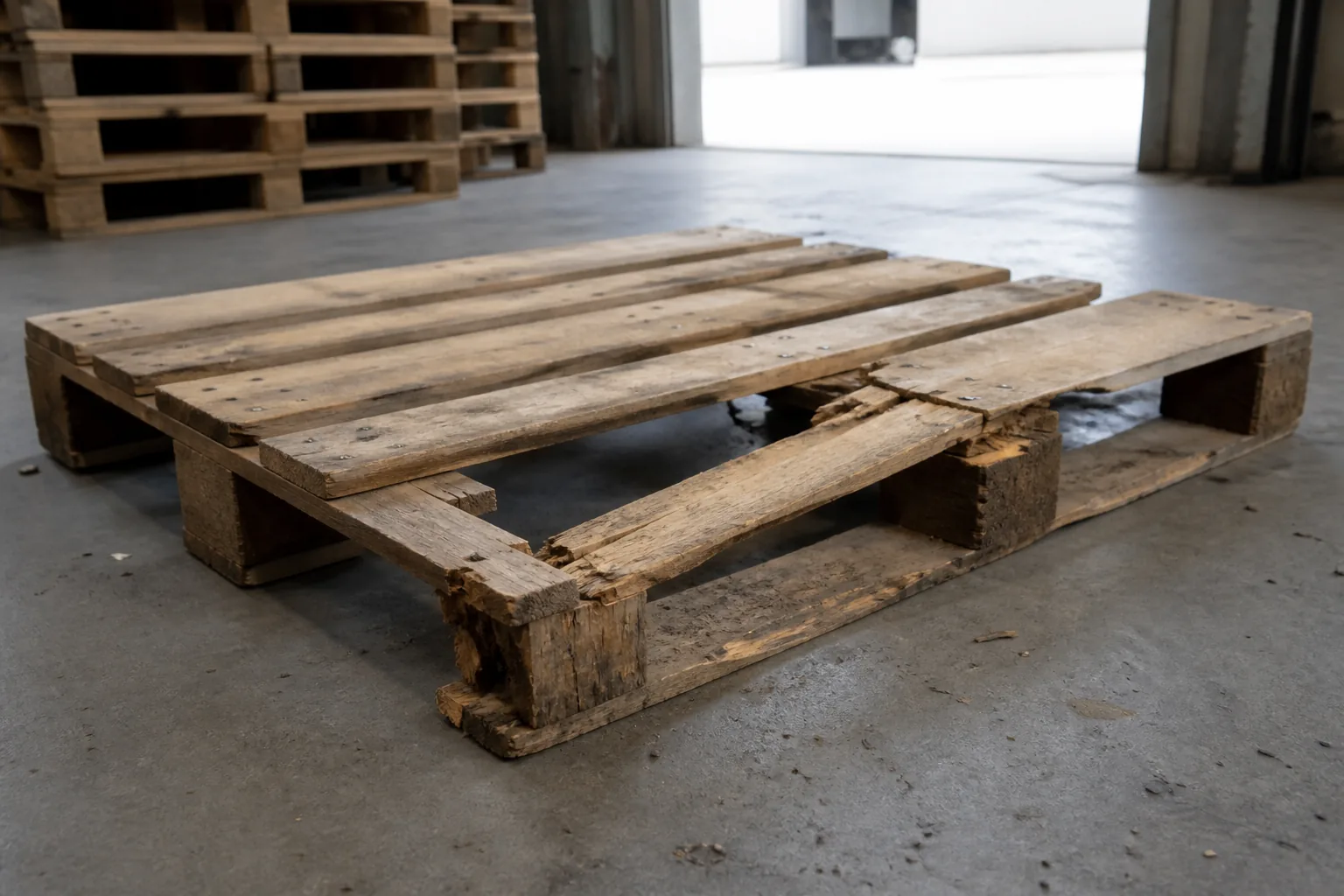
A damaged Euro pallet is more than a cosmetic issue. Broken boards, missing blocks or protruding nails compromise load security, cause secondary damage to goods and can lead to costly disruptions in automated warehouses. Yet pallet damage documentation is neglected in many companies.
This backfires at the latest when a claim needs to be enforced against the supplier or carrier — and the evidence is thin.
When is a Euro pallet considered damaged?
Not every sign of wear renders a pallet unusable. The European Pallet Association (EPAL) clearly distinguishes between normal wear and actual damage. A pallet is considered no longer exchange-grade when:
- One or more load-bearing boards are broken
- Blocks are missing, severely damaged or twisted
- Nails protrude and pose an injury risk
- The EPAL brand marks on the blocks are no longer legible
- The wood is so severely decayed that load-bearing capacity is compromised
In addition, the quality classes (New, A, B, C) play a decisive role: if Class A pallets were contractually agreed, the difference must be documented and claimed when Class C goods are received in return.
Know and observe claim deadlines
The CMR Convention Article 30 sets clear deadlines for reporting transport damage:
Visible damage must be noted immediately upon delivery on the consignment note or delivery note — ideally countersigned by the driver. Failure to note damage at this point makes later claims difficult.
Concealed damage must be reported in writing to the supplier within 7 working days of delivery.
If deadlines are missed, the burden of proof shifts: it is no longer the carrier who must prove they did not cause the damage, but the claimant who must demonstrate the damage occurred during transport. In practice this means: without timely documentation, the claim is effectively forfeited.
How to document damage correctly
Robust damage documentation requires three elements: what is damaged, when was it discovered, and how does the damage look in detail.
1. Inspect immediately upon delivery
Instruct your goods-receiving staff to examine every pallet delivery for damage immediately — before the driver leaves the premises. Visible damage must be recorded on the delivery note at once.
2. Photograph systematically
Individual, blurry phone photos are not sufficient for a claim. Photograph:
- Overview: The entire pallet in the context of the delivery
- Detail: Each piece of damage close-up, so the type and extent are clearly visible
- Markings: The EPAL brand marks and any repair nails
Crucially, the photos must have a timestamp and be attributable to a specific transaction (supplier, delivery note number, date).
3. Classify the damage
Do not describe the damage only in free text ("pallet broken"). Instead, use a standardised assessment — based on the EPAL/GS1 quality classification: which component is affected (top board, bottom board, block, stringer)? What type of damage is it (break, crack, missing, twisted)? Is the pallet still exchange-grade, or must it be removed from the pool?
This structured recording is also the foundation for managing the pallet exchange at the loading dock smoothly.
4. Create and archive a report
Compile all information in a report: photos, damage classification, quantities, supplier data, timestamp. This report is your evidence — both for a direct claim and for potential later legal proceedings.
Why manual documentation fails
In theory, all this sounds feasible. In practice, it fails because there is no time at the loading dock to sort photos, fill in forms and write reports. The result: damage goes undocumented or is incompletely recorded, deadlines pass, and the company bears the costs.
This is precisely where digital solutions for pallet returns come in: an app that guides the employee step by step through the recording process, automatically adds timestamps and supplier references to photos, and generates a ready-made PDF report at the push of a button.
Going one step further is AI-powered damage detection: instead of having the employee manually describe each defect, an AI automatically identifies breaks, missing blocks and other defects in the uploaded photos — providing an objective assessment as the basis for the claim.
Checklist: Documenting pallet damage
Use this checklist for your goods receiving process:
- Inspect the delivery for visible damage before signing
- Note damage immediately on the delivery note and have the driver countersign
- Take photos: overview + detail + markings
- Record the damage type and affected component
- Ensure attribution to supplier, delivery note number and date
- Send the report to the supplier within 7 days
- Archive documentation (at least 1 year, preferably 3 years)
Conclusion
Documenting pallet damage is not optional — it is essential, at least if you do not want to forfeit your claim rights. With a structured approach, clear responsibilities and the right tools, tedious paperwork becomes an efficient process that pays off in hard cash.

Ready for digital pallet returns?
Try the app now for free and be among the first to use Pallet Terminal.
No credit card required