
Euro Pallet Dimensions, Weight and Load Capacity: All Standards at a Glance
Euro pallet dimensions 1,200 × 800 × 144 mm, weight 20–25 kg, load capacity 1,500 kg dynamic and 5,500 kg static — plus EN 13698-1, UIC 435-2 and IPPC.
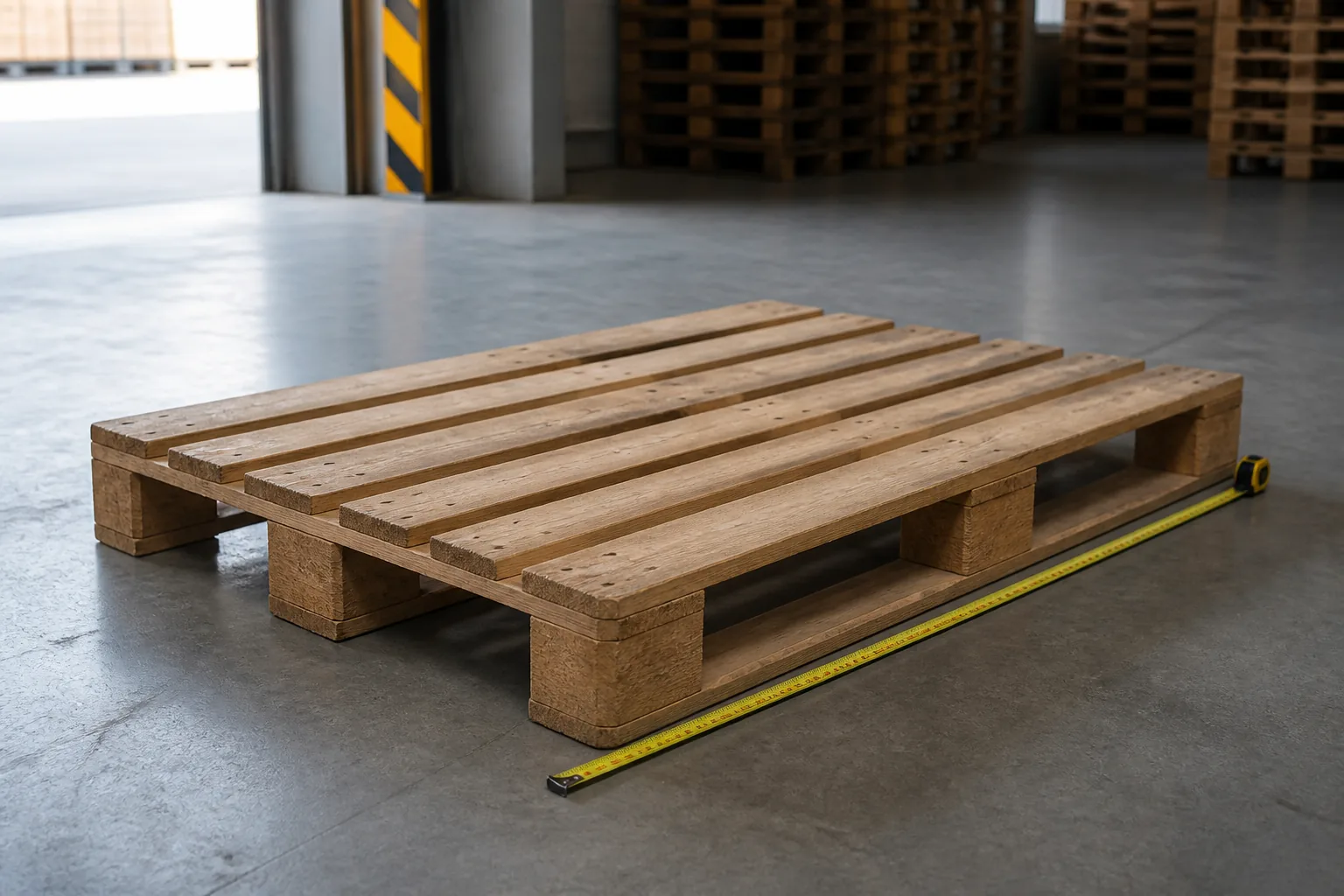
An exchangeable Euro pallet measures 1,200 × 800 × 144 mm (length × width × height), typically weighs 20–25 kg and carries a 1,500 kg payload in transport as well as 5,500 kg as the bottom pallet in a resting stack. These values apply to the standardised EPAL pallet according to EN 13698-1 and UIC leaflet 435-2. Anyone planning goods-in, high-bay storage or freight calculation needs exactly these figures — not approximate estimates.
This overview summarises the binding dimensions, the tare weight, the load capacities and the mandatory markings, and distinguishes the Euro pallet from industrial pallets and half pallets.
Euro pallet dimensions at a glance
The Euro pallet is a four-way pallet: forklifts and pallet trucks can enter it from all four sides. The construction is specified: 11 boards, 9 blocks, typically 78 nails.
| Feature | Dimension |
|---|---|
| Length | 1,200 mm |
| Width | 800 mm |
| Height | 144 mm |
| Base area | 0.96 m² |
| Tare weight | 20–25 kg (typically approx. 22–25 kg) |
| Payload (dynamic) | 1,500 kg |
| Static stacking load | 5,500 kg |
| Entry openings | 4-sided |
The height of 144 mm is not a detail for technicians. It determines whether the pallet fits conveyor systems, shuttle storage and high-bay warehouses. If a pallet deviates because of swelling wood, bent blocks or protruding nails, it is often no longer considered MFH-capable (machine-compatible, conveyor-capable, high-bay capable) — even if it still looks “intact”.
Which standard applies — EN 13698-1 or UIC 435-2?
Both documents describe the same pallet, from different origins. UIC 435-2 comes from the railway sector and shaped the open exchange pool in Europe. EN 13698-1 is the European product standard for the 800-mm-×-1,200-mm wooden flat pallet. The European Pallet Association (EPAL) oversees manufacture, repair and exchangeability.
For everyday warehouse practice this means: A pallet is not a Euro pallet merely because it measures 1,200 × 800 mm. It is exchangeable in the EPAL pool only with the prescribed brand markings, correct construction and without exclusion criteria.
Weight: Why a 3 kg difference becomes expensive
New EPAL pallets usually weigh around 25 kg. Used material can be lighter due to drying, splintering or missing parts — that is not a quality plus, but often a warning sign. In practice, three consequences matter:
Freight and axle load. With 33 pallets on a trailer, a 3 kg difference amounts to around 100 kg. That sounds little, but it shifts payload reserves when the goods themselves are already close to the limit.
Handling. A full pallet with 1,500 kg plus 25 kg tare weight requires different equipment and different care than an empty one. In manual handling at the dock, tare weight is the reason why empty pallets should still not be stacked “on the side”.
Inventory valuation. Anyone who only counts pallets and does not weigh or classify them underestimates the value difference between a dimensionally accurate Class A pallet and a warped Class C pallet. An overview of the classes is in the article on Euro pallet quality classes.
Load capacity: dynamic, static, point load
The frequently cited “1.5-tonne pallet” describes the payload in transport: evenly distributed load, intact pallet, proper securing. The static stacking load of 5,500 kg applies to the bottom pallet in a resting stack — i.e. in block storage, not on the bumpy ramp.
Three rules that are most often violated in practice:
- Point loads halve the safety margin. Barrels, machine feet or unevenly stacked cartons load individual boards. The rated load assumes a distributed load.
- Moisture and prior damage do not count. Broken deck boards, missing blocks or protruding nails void the load capacity. When repair is still worthwhile is covered in the comparison repair or replace a Euro pallet.
- High-bay storage needs dimensional accuracy, not just load capacity. A pallet can carry 1,500 kg and still jam in an automated warehouse if the blocks are crooked.
Mandatory markings: EPAL, EUR and IPPC
The brand markings EPAL and EUR sit on the blocks. They prove that the pallet was manufactured or repaired under licence. If they are missing or illegible, the pallet does not belong in the exchange — regardless of the dimensions.
For international shipping, the IPPC stamp according to ISPM 15 is added. It documents the heat treatment of the wood against pests (HT marking). Without a valid IPPC stamp, the pallet is held at customs in many third countries.
Euro pallet, industrial pallet, half pallet
Not every wooden pallet with a 1.20 m edge length is a Euro pallet.
| Type | Dimensions | Typical use |
|---|---|---|
| Euro pallet (EPAL) | 1,200 × 800 × 144 mm | Open exchange, DACH/CEE, standard dock |
| Industrial pallet | 1,200 × 1,000 mm | Chemicals, beverages, some industrial ERP |
| Half pallet / Düsseldorf pallet | 800 × 600 mm | Retail, display, part loads |
Anyone who mixes industrial pallets and Euro pallets in the same goods-in without separating them creates wrong accounts, wrong slot planning and disputes at exchange. Dimensions are the first filter — quality and documentation follow.
What goods-in should check in 30 seconds
A quick visual inspection is enough to find the most expensive deviations:
- Do the outer dimensions roughly match — no severely warped blocks, no protruding boards?
- Are the EPAL/EUR markings and the IPPC stamp legible?
- Does the pallet carry the agreed quality class?
- Are there breaks, missing blocks or nails that endanger the load capacity?
Anyone who not only sees this but records it can later prove differences. How to do this in a legally sound way is described in damage documentation at goods-in.
Conclusion
The Euro pallet is a standardised working tool, not an approximate wooden frame. 1,200 × 800 × 144 mm, 20–25 kg, 1,500 kg dynamic, 5,500 kg static — plus EPAL markings and IPPC stamp — are the basis for exchange, high-bay storage and freight. Anyone who knows these values at goods-in and documents deviations prevents consequential damage in conveyor technology, the pallet account and claims.
Frequently asked questions
How large is a Euro pallet in centimetres? 120 × 80 × 14.4 cm. In logistics, millimetres are standard, because a 4 mm height deviation is already relevant in a high-bay warehouse.
How much does an empty Euro pallet weigh? Typically 20 to 25 kilograms. New EPAL pallets are usually close to 25 kg; lighter specimens are often more worn.
How much weight may be placed on a Euro pallet? 1,500 kg payload with evenly distributed load. In a resting stack the bottom pallet carries up to 5,500 kg, provided it is undamaged.
Is every 1200×800 pallet an EPAL pallet? No. Only pallets with correct construction and valid brand markings are exchangeable. Dimension copies without a licence do not belong in the open pool.
What does MFH mean for Euro pallets? Machine-compatible, conveyor-capable, high-bay capable. Dimensions, blocks and surface must be within tolerance — not just the rated load.

Ready for digital pallet returns?
Try the app now for free and be among the first to use Pallet Terminal.
No credit card required